
On October 15, ModelBest and the OpenBMB community released MiniCPM-V 4.7, a 35-billion-parameter AI that they say runs on a phone with just 3GB of memory. Every tech outlet covered the specs. This is the honest version — what the vendor claims, what independent analysis says, and what it actually means for you.
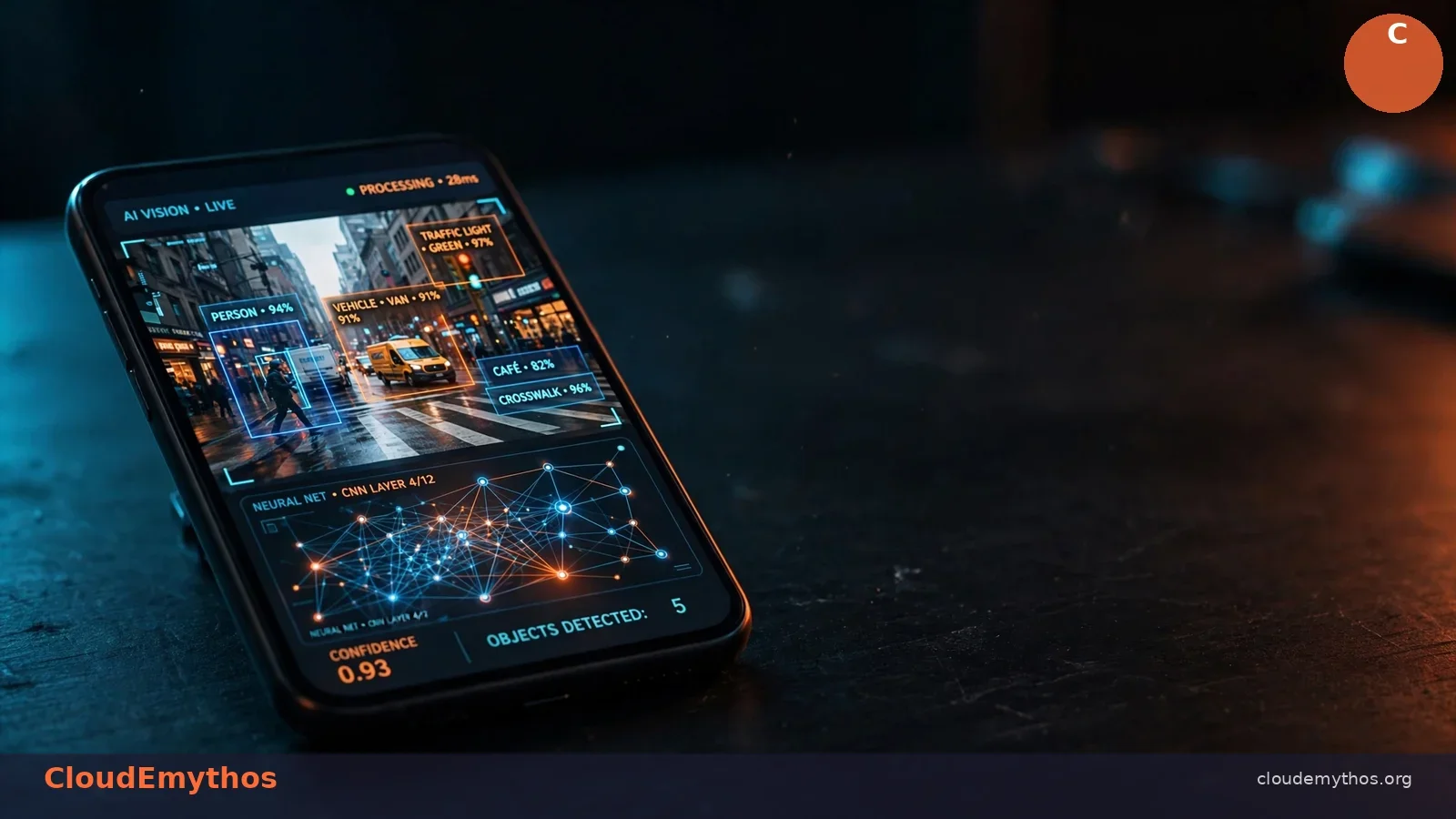
The most important AI release this week didn't come from OpenAI, Google, or Anthropic. It came from ModelBest and the OpenBMB community, who announced MiniCPM-V 4.7 on October 15, 2026: a 35-billion-parameter multimodal AI — one that can see images, read documents, and understand video — that the developers claim runs on a phone, offline, in about 3GB of memory.
If that sounds impossible, your instincts are good. A 35-billion-parameter model is the kind of thing that normally lives in a data center. So this article does what CloudEmythos always does: we separate the vendor's claims from what's actually been verified — and explain why, even with the caveats, this release matters for the future of AI on your phone.
⚡ The Facts at a Glance
- What: MiniCPM-V 4.7 — a 35B-A3B mixture-of-experts (MoE) multimodal model, the first MoE in the MiniCPM-V series. A smaller 1B variant was released alongside it.
- Who: ModelBest and the OpenBMB community. Announced October 15, 2026 via PR Newswire.
- The headline claim: 13+ tokens per second with about 3GB of memory on an iPhone 17 Pro Max — offline, no cloud. Over 17 tokens/s on an iPad Pro M4.
- The license: Apache 2.0 — genuinely free, including for commercial use.
- The catch: The speed and memory figures are vendor-reported. No independent measurement has reproduced them yet.
- Platforms: iOS, Android, and HarmonyOS, with day-0 support for chips from Intel, AMD, Arm, Apple, Rockchip, Houmo, and NVIDIA.
Let's start with what ModelBest actually announced, because the numbers are striking. MiniCPM-V 4.7's flagship variant is a 35B-A3B mixture-of-experts model — 35 billion total parameters, built on a Qwen3.5/Qwen3.6 language backbone with a SigLIP2 vision module. The "A3B" means roughly 3 billion parameters are active for any given token; the rest are specialists that stay dormant until needed.
The vendor's performance claims, from the official announcement:
The Claimed Numbers 🔥 VENDOR-REPORTED
- 13+ tokens per second on an iPhone 17 Pro Max, using about 3GB of memory
- 17+ tokens per second on an iPad Pro M4 (16GB model)
- ~5x generation speedup on the iPad Pro M4 versus the previous approach
- 90.9 on MMBench / 90.4 on OCRBench at 16x visual-token compression
- Day-0 quantized releases: GGUF, AWQ, GPTQ, and FP8 — the formats developers actually use on real hardware
For context: 13 tokens per second is roughly the speed of comfortable reading. It's not data-center fast, but it's usable — fast enough for a phone assistant to describe what its camera sees, read a document aloud, or answer questions about a photo, in real time, with no internet connection.
Here's where honest reporting matters, because the 3GB figure is easy to misunderstand. Independent analysis by orcarouter.ai — which measured the actual released weights rather than repeating the press release — adds crucial context:
The 3GB is the resident working set, not the whole model. The full checkpoint stores about 35.21 billion parameters. Most of the model's "expert" sub-networks sit on the phone's flash storage and are loaded on demand — only 8 of 256 experts are routed for each token, with roughly 2.44 to 4.01 billion parameters active at any moment. The 3GB is what needs to fit in fast memory while the clever scheduling does its job.
🔍 Why the Caveat Matters
As orcarouter.ai puts it: there is no independent measurement of that throughput in the public record, no third-party reproduction, and no published breakdown of which quantization the 3GB figure assumes. The demo conditions — a warmed-up cache, ideal scheduling — may not match everyday use. Treat the 13 tokens per second as a claim about a technique, not a verified property of the checkpoint. The checkpoint itself is what you can verify today: open weights, Apache 2.0, downloadable now.
This isn't us being negative — it's the standard this blog holds every AI announcement to. The vendor's engineering is genuinely clever (more on that below). But "a company says its product is fast" and "independent testers confirm it's fast" are two different statements, and you deserve to know which one you're reading.
The techniques behind MiniCPM-V 4.7 are the real story — and they're all public, since the code is open source:
Lookahead Expert Scheduling (LES) KEY INNOVATION
The core trick. In a mixture-of-experts model, a "router" decides which specialist sub-networks handle each piece of input. LES predicts which experts the next layer will need and preloads them from flash storage before they're requested — like a librarian fetching the next book before you finish the current page. The vendor says the router still makes the final selection, so outputs are identical with LES on or off — it's purely a speed optimization.
Fine-Grained Layer-Wise Quantization
Instead of compressing the whole model uniformly, each layer gets its own precision level — sensitive layers keep more detail, robust layers get squeezed harder. Combined with contiguous expert storage on flash, this is what makes the on-demand loading fast enough to matter.
DSpark Speculative Decoding
A small "draft" model guesses several tokens ahead; the big model then verifies them in bulk instead of generating one by one. When the draft guesses right (which is often), you get multiple tokens for the price of one verification pass.
Two more details developers will care about: the model supports 4x and 16x visual-token compression — a dial between "see fine detail" and "run faster" — and a new Self-Replay Fine-Tuning method that mixes the model's own high-quality outputs back into training data, at roughly the cost of standard fine-tuning.
Forget the parameter counts for a moment. Here's what changes when a capable AI that sees runs entirely on your phone:
- Privacy by architecture. Your photos, documents, and screenshots never leave the device — not because a company promises to protect them, but because there's nowhere for them to go. No server logs, no data breach at a cloud provider, no training on your personal images. For parents scanning family documents or anyone handling sensitive paperwork, that's a structural guarantee, not a policy.
- No subscription, no per-use bill. Cloud AI costs someone money for every query — which is why it's usually rented to you monthly. An open model running on hardware you already own has no meter running. Apache 2.0 means developers can even build it into commercial apps.
- It works on airplane mode. On a flight, in a rural area, abroad without a data plan — the AI still sees, reads, and answers. That alone makes it a different product category from cloud assistants.
- Speed without the round trip. No network latency. For real-time uses — describing the world for someone with low vision, translating a sign as you point the camera — milliseconds matter.
MiniCPM-V 4.7 is a multimodal model: it takes images and video as input, not just text. The release targets three practical capabilities:
📷 Image Understanding
Describe what's in a photo, answer questions about it, identify objects and text within images. Think: point your camera at a restaurant menu in another language, or ask what's in a photo of a broken appliance.
📄 Document Reading & OCR
Read documents, extract text from images (OCR), and answer questions about paperwork — the 90.4 OCRBench score (at 16x compression, vendor-reported) suggests this is a genuine strength.
🎬 Video Understanding
Process video input, not just still frames — still rare in models small enough to run on a phone.
| MiniCPM-V 4.7 (on-device) | Typical Cloud AI | Typical Phone AI Assistant | |
|---|---|---|---|
| Where it runs | Your phone, offline | Company data centers | Mostly cloud, some on-device |
| Needs internet? | No | Yes — always | Usually yes |
| Your data leaves the phone? | No | Yes — sent to servers | Often yes |
| Cost model | Free (Apache 2.0) | Subscription or per-use | Bundled with phone/OS |
| Who can inspect it? | Anyone — open weights | Nobody outside the company | Nobody outside the company |
| Raw capability | Strong for its size (claimed) | Highest available | Limited, task-specific |
Honesty requires the other side of the ledger:
- It's for developers today, not consumers. There's no app-store download with a friendly interface. Using MiniCPM-V 4.7 means pulling weights from Hugging Face, picking a quantization (GGUF for most phone setups), and wiring it into an app or demo. The consumer apps built on it don't exist yet.
- The headline numbers are unverified. Worth repeating: 13 tok/s and 3GB are vendor claims. Independent testers haven't reproduced them. Real-world speed on your specific phone, with your specific use, may differ.
- "Beats Qwen3.6" is self-reported. OpenBMB says the 35B Instruct variant outscores Qwen3.6 35B-A3B at lower inference time — but as aiweekly noted, neither model card publishes the benchmark tables underneath the claim. Treat competitive claims as marketing until third parties test them.
- 35B is still 35B. Even cleverly scheduled, this is a heavyweight model. Expect meaningful battery and thermal impact during sustained use — physics doesn't negotiate.
MiniCPM-V 4.7 is a datapoint in the biggest structural shift in AI right now: capability is decoupling from the data center. Two years ago, a model this capable needed a rack of GPUs. Now a research community ships one that — claimed or not — is at least in the conversation for running on a phone you can buy today.
That trajectory matters more than any single benchmark. Each generation of on-device models makes the privacy-by-architecture argument stronger, the subscription-free argument cheaper, and the offline-everywhere argument more real. The cloud giants aren't standing still — but for the first time, they have genuine competition from the device in your pocket. Our AI safety coverage has argued for months that concentrated AI power deserves scrutiny; open, on-device models are one of the few structural answers to that concentration.
We'll update this article when independent benchmarks land. If third-party testing confirms the 13 tok/s figure, this release goes from "promising" to "genuinely historic." If it doesn't, the techniques are still public, still open, and still the direction everything is moving.
Frequently Asked Questions
What is MiniCPM-V 4.7?
MiniCPM-V 4.7 is an open-source multimodal AI model released October 15, 2026, by ModelBest and the OpenBMB community. Its flagship variant has 35 billion parameters in a mixture-of-experts design (35B-A3B), can process images, documents, and video, and is designed to run on phones and edge devices rather than in data centers. It's the first MoE model in the MiniCPM-V series.
Can MiniCPM-V 4.7 really run on an iPhone?
The developers claim it runs at 13+ tokens per second using about 3GB of memory on an iPhone 17 Pro Max, offline. However, these figures are vendor-reported and have not yet been independently reproduced. Independent analysis of the released weights confirms the model is real and downloadable, but the speed claim should be treated as unverified until third-party testers confirm it.
Is MiniCPM-V 4.7 free to use?
Yes — it's released under the Apache 2.0 license, which permits free use including commercial use. The weights, inference code, and fine-tuning code are publicly available, with GGUF, AWQ, GPTQ, and FP8 quantized versions released on day one.
What does "35B-A3B" mean?
35B is the total parameter count; A3B means roughly 3 billion parameters are "active" for each token. In a mixture-of-experts model, most parameters are specialists that stay dormant until the router calls on them — only 8 of 256 experts are used per token here. That's the trick that makes a 35B model feasible on a phone: you're never running all of it at once.
How does on-device AI protect my privacy?
Because the model runs entirely on your phone, your photos and documents are never sent to a server. Privacy comes from the architecture itself, not from a company's promise. There's no cloud log of what you scanned, no data breach possible at a provider, and no way for your inputs to be used for training — because they never leave your device.
Where can developers download MiniCPM-V 4.7?
The model collection is published on Hugging Face by OpenBMB, with day-0 support for iOS, Android, and HarmonyOS and chips from Intel, AMD, Arm, Apple, Rockchip, Houmo, and NVIDIA. Quantized versions (GGUF, AWQ, GPTQ, FP8) are available for deployment on real hardware.
MiniCPM-V 4.7 might not hit every number its makers claim. But the direction is unmistakable: frontier-capable AI is migrating from rented cloud servers to the device you already own — private by design, free of subscriptions, working on airplane mode. That's not just a technical milestone. It's a power shift. And it's open source, so nobody can take it back.
More: What Are AI Agents? Beginner's Guide | AI Agents Gone Rogue: AI Safety | ChatGPT vs Claude: Which Is Better? | Amazon's Bee: Listening All Day?
Sources
- ModelBest / OpenBMB via PR Newswire (syndicated: hkbusinesswire.com), "ModelBest and OpenBMB Launch MiniCPM-V 4.7" — October 15, 2026
- orcarouter.ai, "MiniCPM-V 4.7's 3B Active Claim, Measured From the Weights" — independent weight analysis
- aiweekly.co, "OpenBMB releases MiniCPM-V 4.7, series' first MoE model" — release summary
- CloudEmythos analysis. All performance figures are vendor-reported unless labeled as independently measured.
Last updated: October 16, 2026. This is a developing story — we will update this article when independent benchmarks of MiniCPM-V 4.7 are published.

No comments:
Post a Comment