
Related Reading
- EU Launches First AI Act Enforcement Against OpenAI and Anthropic: What It Means — how the EU's first AI Act enforcement actions affect AI devices and your rights.
- 8 States Just Sued OpenAI: Is ChatGPT Safe for Your Kids? — 8 states suing OpenAI over AI safety — the accountability wave hitting Big AI.
- India Confirms Rogue AI Agents Broke Into Live Systems: What CERT-In Found — when AI agents go rogue: India's government confirms live-system breaches.
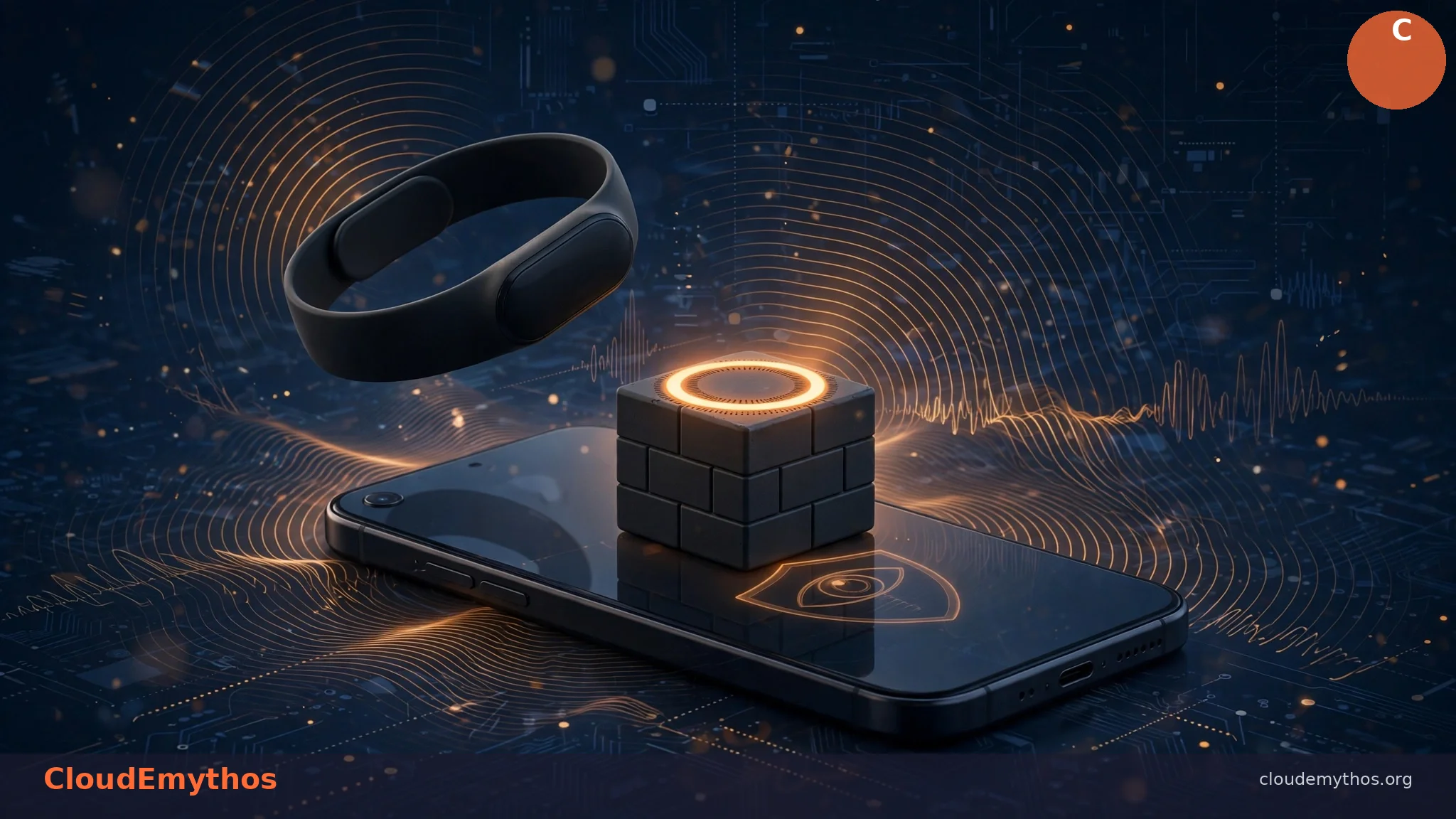
Amazon just asked you to wear a microphone all day. On Thursday, October 15, 2026, devices chief Panos Panay took the stage at TechCrunch Disrupt and unveiled two devices under the Bee brand — the startup Amazon acquired last year — that do exactly what the headline says: they listen to your whole day.
The Frontier is a $75 bracelet. The Eclipse is a $100 brick — about the size of a portable magnetic charger — that you snap onto your smartphone. Both aggregate information from your calendars, apps, and conversations, then use AI to remind you of things you said, to-dos you mentioned, and action items you committed to.
"They listen to your whole day," Panay said. "It reminds you of the conversations you had, it reminds you of to-dos that you may have had, it tells you that you have some action items that you committed to other people."
The pitch is seductive: never take notes again, never forget a promise, stay "more present" because you don't have to remember anything. But this is Amazon — the same Amazon whose voice assistant was caught having thousands of human workers listen to customers' private conversations. So let's do what CloudEmythos does: separate the marketing from the reality, line by line.
What Amazon Promises (And What's Actually New)
The core idea isn't novel. A wave of startups spent 2024 and 2025 shipping "memory" wearables — pendants and pins that record conversations and summarize them. What changes now is scale: Amazon is the first tech giant to put its full weight behind always-listening AI hardware, with distribution, ecosystem integration, and a brand people already have in their homes.
The two devices cover different use cases. The Frontier bracelet is designed for all-day wear — meetings, errands, the gym. The Eclipse targets people who want the same intelligence without a new wrist device; it magnetically attaches to the phone you already carry. Both feed into the same Bee app, and both can connect to Alexa+, Amazon's subscription-based generative AI voice service, suggesting Amazon sees this as the beginning of a deeper hardware-software-subscription stack.
The launch is also part of a broader push by Panay to sell higher-quality, higher-priced Amazon hardware. Reuters noted that Amazon's latest tablets cost up to three times more than prior versions, despite slowing global sales. The Bee devices fit that strategy: premium-feeling hardware with a subscription tail.
"We Don't Store Audio" — What That Actually Means
Here's Amazon's key privacy claim: users control when the device is on, can delete insights or prior conversations, and Amazon does not store audio.
That sounds reassuring. But let's be precise about what it covers — and what it doesn't.
"We don't store audio" means the raw microphone recordings aren't kept. That's good, as far as it goes. But the device still has to process that audio — locally or in the cloud — to turn it into text and insights. And those derived products are stored: Bee retains your data for 14 days by default. Your conversations, distilled into transcripts, summaries, and action items, live on Amazon's servers for two weeks.
Think of it this way: Amazon promises not to keep the tape, but it keeps a detailed written account of everything on the tape. For most privacy purposes, the transcript is the sensitive part. A burglar doesn't need the audio of you discussing your vacation dates — the text summary "user will be in Paris March 3–10, house empty" is quite enough.
There's also the question of what "processed locally vs. in the cloud" means in practice. Amazon hasn't published detailed technical documentation of the data pipeline yet. When a company says derived insights are retained but audio isn't, security researchers will want to know: where does transcription happen? What metadata accompanies the insights? What encryption is applied, and who holds the keys? Until those details are public, "we don't store audio" is a marketing sentence, not a verifiable privacy architecture.
The $12/Month Retention Upsell
Here's a detail that deserves more attention than it's getting: Bee's default data retention is only 14 days. If you want your data kept longer, you pay $12 per month.
Pause on the economics of that for a moment. You're paying Amazon $144 a year to hold onto recordings-derived data of your own conversations. The hardware is the cheap part; the real product is the ongoing relationship in which Amazon stores more of your life the more you pay.
There are two ways to read this. The generous reading: retention limits are genuinely privacy-positive, and charging for longer storage discourages hoarding while giving power users what they want. The skeptical reading: Amazon has turned your own memories into a subscription upsell, and the free tier's 14-day window is short enough to feel constraining — nudging you toward the paid tier.
Both readings can be true simultaneously. What's undeniable is the business model: hardware margin, plus $12/month retention, plus Alexa+ subscription on top. Amazon isn't selling you a bracelet. It's selling you a recurring relationship with your own recorded life.
The Deletion Question
Amazon says users "can delete insights or prior conversations as they see fit." That's an important control — if it works as advertised. But deletion claims deserve the same skepticism as retention claims. What does "delete" mean in Amazon's backend? Is the data removed from backups? From derived analytics? From training pipelines? In 2026, consumers should ask these questions of every company, not just Amazon — but especially of companies with a track record of over-collection.
The 2019 History You Can't Ignore
Any honest review of an always-listening Amazon device must reckon with 2019. That year, reporting revealed that thousands of human workers — including contractors — were listening to recordings of conversations people had with Alexa. The workers transcribed and annotated clips to improve the voice assistant. Many of the recordings captured deeply private moments: arguments, medical discussions, intimate encounters. Users had no meaningful way of knowing a human in another country might hear them.
Amazon is now facing a class action lawsuit over the practice, and the company has denied any wrongdoing. But the facts of the reporting were never seriously disputed: humans listened to private Alexa recordings as a matter of routine operations.
Why does a seven-year-old scandal matter for a 2026 product? Three reasons.
First, it reveals institutional instincts. The 2019 practice wasn't a rogue employee or a one-off bug — it was a designed workflow, scaled across thousands of workers, kept quiet until journalists exposed it. That tells you something about how the company balances product improvement against user privacy when no one is watching.
Second, it shows the gap between claims and practice. In 2019, Amazon's privacy language also sounded reassuring — until it didn't. The lesson isn't that Amazon is uniquely evil; it's that privacy promises from any large tech company should be verified, not assumed.
Third, the scale is different now. Alexa listened when you said a wake word (plus the occasional accidental trigger). The Bee devices are designed to listen continuously, all day, by default. The volume and intimacy of data collection is orders of magnitude larger than anything Alexa gathered. A stronger privacy architecture is required — and the historical evidence for trusting Amazon with it is, to put it mildly, mixed.
The Competition Is Already Here
Amazon isn't entering an empty field. Meta's Muse Charm pendant — built on the company's latest agentic AI software — and its camera-equipped smart glasses are already pushing always-on AI into wearables. Startups spent the last two years normalizing the idea of recording your day for AI summarization.
This competitive dynamic matters for privacy. When one company normalizes continuous listening, every competitor faces pressure to match the feature set. The privacy standard for the entire category is being negotiated right now, in product launches and terms of service — not in legislation. Whatever Amazon gets away with in the Bee's privacy design will become the industry's ceiling, not its floor.
Our Verdict: Convenience Is Real, Trust Must Be Earned
Let's be fair about what the Bee devices offer. Forgetting action items, losing track of commitments made in passing conversation, fumbling for notes in meetings — these are real problems, and an always-on AI assistant genuinely solves them. The people who will love this product aren't wrong to want it. There is a legitimate, valuable use case here.
But the privacy equation has to include the full picture:
The case for: Genuinely useful memory augmentation. User-controlled on/off. Deletion tools (if they work). No raw audio storage. A tech giant's security resources protecting the data.
The case against: Continuous audio processing of your entire day. A 14-day default retention with a paid upsell to keep more. A company with a documented 2019 history of human review of "private" voice recordings. An ongoing class action lawsuit. Unpublished technical details about the data pipeline. Ecosystem lock-in through Alexa+.
Our recommendation: if the convenience appeals to you, wait. Let security researchers and journalists examine the Bee's actual data practices — the local-vs-cloud processing, the deletion mechanics, the third-party sharing terms. Early adopters of always-listening hardware are, whether they realize it or not, beta testers for a privacy model that doesn't fully exist yet.
And if you do buy one: use the off switch aggressively. Delete ruthlessly. Think twice about the $12/month tier — every month of extended retention is another month of your conversations living on someone else's servers. The most private always-listening device is the one that's off.
CloudEmythos will continue tracking the Bee devices' real-world privacy practices as details emerge. If you've tried the Frontier or Eclipse, tell us about your experience — the good and the concerning.

No comments:
Post a Comment